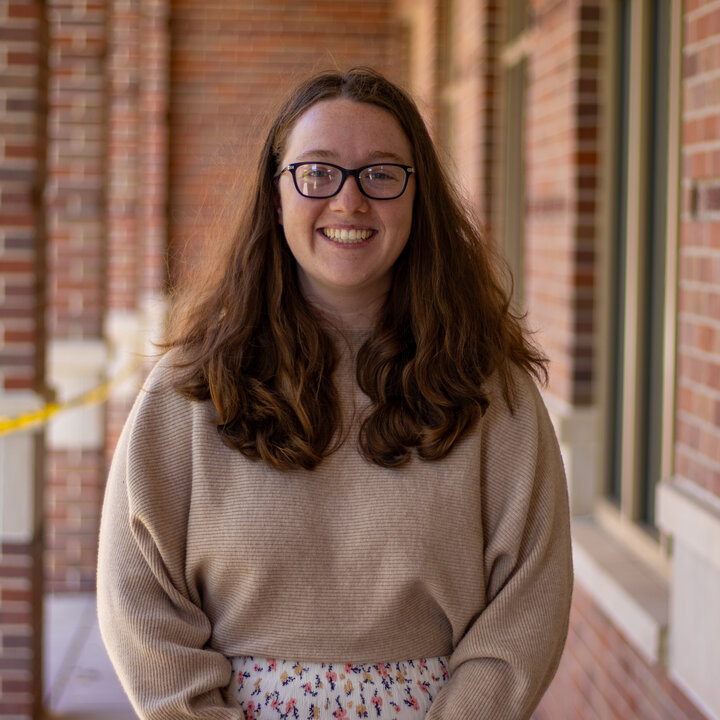
Alisha Bevins
Assistant Professor of Practice Jeffrey S. Raikes School of Computer Science and Management, School of Computing University of Nebraska-Lincoln
Contact
- Address
-
NH W205
Lancaster, NE 68588-0523 - Phone
-
402-472-2401 On-campus 2-2401
-
abevins2@unl.edu
- Website
-
Google Scholar
Alisha Bevins is an Assistant Professor of Practice jointly appointed in the Jeffrey S. Raikes School of Computer Science and Management and the School of Computing at the University of Nebraska–Lincoln. Her work centers on designing human-robot and human-computer interactions that foster intuitive communication. Her teaching emphasizes project-based learning, collaboration, and hands-on exploration that connects computing concepts with real-world design and development.
Before joining the faculty, Bevins conducted research in the Nebraska Intelligent MoBile Unmanned Systems (NIMBUS) Lab, where she focused on human-robot interaction. Her projects explored diverse topics including how people perceive and respond to aerial robot behavior, augmented-reality museum tours with virtual robot guides, acceptance of robots in elementary classrooms, and drone-based sensing systems for environmental data collection. Bevins earned her Ph.D. in Computer Science from the University of Nebraska–Lincoln in 2025, advised by Dr. Brittany Duncan. She also holds an M.S. in Computer Science (2021) and a B.S. in Mechanical Engineering (2019), with minors in Robotics and Computer Science, all from UNL.
Bevins has been recognized as an ACM/IEEE HRI Pioneer (2025) by the Human-Robot Interaction community and as a Graduate Teaching Fellow by the UNL College of Engineering. Outside the classroom, Bevins enjoys baking and visiting Disney parks with her family. Her favorite movie, Meet the Robinsons, reflects her love of creativity, curiosity, and forward-looking ideas, qualities she hopes to inspire in her students and embody in her teaching.
TEACHING
Jeffrey S. Raikes School Courses
RAIK 184H — Software Development Essentials (4 credits, second semester)
RAIK 270H — Statistics and Applications (3 credits, third semester)
Academic Lead for RAIK 401H & 402H — Design Studio I & II (6 credits)
School of Computing Courses
CSCE 155T — Computer Science I: Informatics Focus
CSCE 311 — Data Structures and Algorithms for Informatics
CSCE 378 — Introduction to Human-Computer Interaction
Peer Reviewed Publications
Bevins, A., & Duncan, B. A. (2025, March). Impact of Flight Paths and Context on Human-Aerial Robot Interaction. In Companion of the 2025 ACM/IEEE International Conference on Human-Robot Interaction.
Bevins, A., Kunde, S., & Duncan, B. A. (2024, March). User-Designed Human-UAV Interaction in a Social Indoor Environment. In Proceedings of the 2024 ACM/IEEE International Conference on Human-Robot Interaction (pp. 23-31).
Bevins, A., & Duncan, B. A. (2021, Dec). Aerial flight paths for communication. In Frontiers in Robotics and AI, 8, 719154.
Bevins, A., & Duncan, B. A. (2021, March). Aerial flight paths for communication: How participants perceive and intend to respond to drone movements. In Proceedings of the 2021 ACM/IEEE International Conference on Human-Robot Interaction (pp. 16-23).
Bevins, A., McPhaul, N., & Duncan, B. A. (2020, Nov). Content Is King: Impact of Task Design for Eliciting Participant Agreement in Crowdsourcing for HRI. In Social Robotics: 12th International Conference, ICSR 2020, Proceedings 12 (pp. 640-651).
Duncan, B. A., Beachly, E., Bevins, A., Elbaum, S., & Detweiler, C. (2018, May). Investigation of communicative flight paths for small unmanned aerial systems. In 2018 IEEE International Conference on Robotics and Automation (ICRA) (pp. 602-609).
Acharya, U., Bevins, A., & Duncan, B. A. (2017, September). Investigation of human-robot comfort with a small unmanned aerial vehicle compared to a ground robot. In 2017 IEEE/RSJ International Conference on Intelligent Robots and Systems (IROS) (pp. 2758-2765).